
Birding in Greece
Trip report
Two Weeks of Spring Migration across Greece
A private two-week journey through mainland Greece at the height of spring migration: wetlands, mountains and historic sites, with local food and small local places to stay close to the birds.
- Dates
- 23 Apr 2023 to 8 May 2023 (16 days)
- Tour type
- Dedicated Birding, Private
- Region
- Attica, Western Greece, Thessaly, Central Macedonia and Central Greece
- Guides
- Thanasis Tsafonis
- Group
- Two guests
- Species
- 216
Highlights
- A Demoiselle Crane, a rare visitor to Greece
- Ruppell's Warbler on Mount Hymettus, on the edge of Athens
- Great Spotted Cuckoo in the Spata fields and Ferruginous Ducks at Schinias
- Dalmatian and Great White Pelicans at Lake Kerkini
- Semicollared Flycatcher and eight species of woodpecker
- Levant Sparrowhawk, Pallid Harrier and Lesser Spotted Eagle on migration
- Masked Shrike and Cretzschmar's Bunting
- Rock Partridge on Mount Lailias and Alpine Chough on Mount Parnassos
The tour
This private tour was timed for the height of spring migration, and its focus was the birds: wetlands full of herons, waders and terns, raptors on passage, forests with woodpeckers and flycatchers, and the special warblers, shrikes and buntings of the eastern Mediterranean.
Just as much, it was a journey through Greece. The route ran from Athens to Cape Sounion, west to the Messolonghi lagoons, north through Meteora and Thessaly to the great wetlands of Macedonia, the Axios Delta and Lake Kerkini, and back south by way of Mount Parnassos and the island of Euboea. We ate local food along the way and stayed in small, local places close to the birding sites, so the best hours of the day were spent in the field, not on the road. In spring the countryside is also full of wildflowers, a bonus on many of our walks.
Over sixteen days the group recorded 216 species of birds.
Day by day
- 1
Day 1 · Sun 23 Apr
Arrival in Athens
Arrival at Athens International Airport and transfer to our hotel in the city centre.
- 2
Day 2 · Mon 24 Apr
Mount Hymettus & Athens Historic Centre
Mount Hymettus
Our first morning took us up Mount Hymettus, the mountain that rises straight out of the eastern suburbs of Athens. We started in the old pine woods around Kaisariani Monastery and then climbed to the open slopes of the ridge. Our main target was Ruppell's Warbler, which breeds in the low scrub vegetation along the ridge, and it was a real pleasure to start the trip with this Aegean speciality.
At Kaisariani we also paid a quiet visit to the local Tawny Owl, which spends its days asleep in one of the hollows of the old trees, and watched it from a distance so as not to disturb it. Migrants were moving through all morning, with Eastern Black-eared Wheatears, Eastern Subalpine Warblers and more along the ridge.
The rest of the day belonged to Athens itself: a walk through the historic centre below the Acropolis, the National Garden, and a long dinner of local Greek food and wine.
- 3
Day 3 · Tue 25 Apr
Cape Sounion & East Attica
Cape Sounion, Spata Fields, Schinias National Park
We began at Cape Sounion, at the Temple of Poseidon on the cliffs above the Aegean. Friendly Chukars walked around the temple, Blue Rock Thrushes sang from the rocks, and Yelkouan Shearwaters passed low over the sea below the headland, with migrants in the scrub around the site.
From the coast we turned inland to the open farmland of Spata in search of Great Spotted Cuckoos. In the afternoon we finished at Schinias National Park, the wetland behind the long beach of Marathon and the most important coastal wetland in Attica. Schinias is the place near Athens for Ferruginous Duck, a species listed as Near Threatened worldwide, and its quiet, reed-fringed pools did not disappoint, while more migrants were moving through the marsh.
- 4
Day 4 · Wed 26 Apr
Messolonghi Lagoons National Park
Messolonghi Lagoons NP
We left Athens in the morning and crossed to western Greece over the Rio–Antirrio bridge, arriving around midday at the Messolonghi lagoons, one of the largest wetland complexes in Greece.
We spent the afternoon on the lagoons and saltpans. Here we saw our first Dalmatian Pelicans of the trip, along with Slender-billed Gulls, Caspian Terns and plenty of flamingos. A pair of Stone-curlews on the dry ground beside the lagoon was a nice find, and Eurasian Penduline Tits were calling in the reeds.
Later in the afternoon we visited the historic town of Messolonghi, where we walked through the Garden of Heroes, a peaceful park honouring those who fought for Greek independence, and then sat down to a dinner of local food in a town well known for its fresh fish from the lagoon and its avgotaracho, the local cured fish roe.
- 5
Day 5 · Thu 27 Apr
Louros & Lesini
Messolonghi Lagoons NP, Lesini ash forest & village
The next morning we explored Louros, an area of wet meadows and channels inside the national park, and it turned out to be the busiest morning of the first week. The best moment was a Pallid Harrier heading north over the meadows, one of the top birds of the trip. Spotted Redshanks were feeding in the channels, and on the drier ground we found Red-throated Pipits and Calandra Larks.
In the afternoon we walked in the Lesini ash forest, one of the last flooded riverine forests in Greece and a cool, quiet place after the open lagoons. Middle Spotted Woodpeckers, a Lesser Spotted Woodpecker and a singing Wood Warbler were the highlights. We ended the day with a walk through Lesini village, where Lesser Kestrels nest in the old houses. Strolling along the streets with the falcons calling and flying to their nests all around us, right among the homes of the villagers, was a lovely way to finish the day.
- 6
Day 6 · Fri 28 Apr
Meteora
Mourgani riparian woodland, Meteora
We drove north over the Pindos mountains into Thessaly and stopped on the way at the riverside woodland of Mourgani. This was the place for one of our main targets, Semicollared Flycatcher, a scarce breeding bird in Greece, and we found several of them at their nest holes in the old plane trees. European Rollers and European Bee-eaters were also around the woodland edge.
In the afternoon we arrived at Meteora, with its monasteries built on top of huge rock pillars. We visited some of the monasteries and stopped at the best viewpoints over the rocks and the valley below, while Alpine Swifts and Eurasian Crag Martins flew in and out of their nests on the cliffs around us.
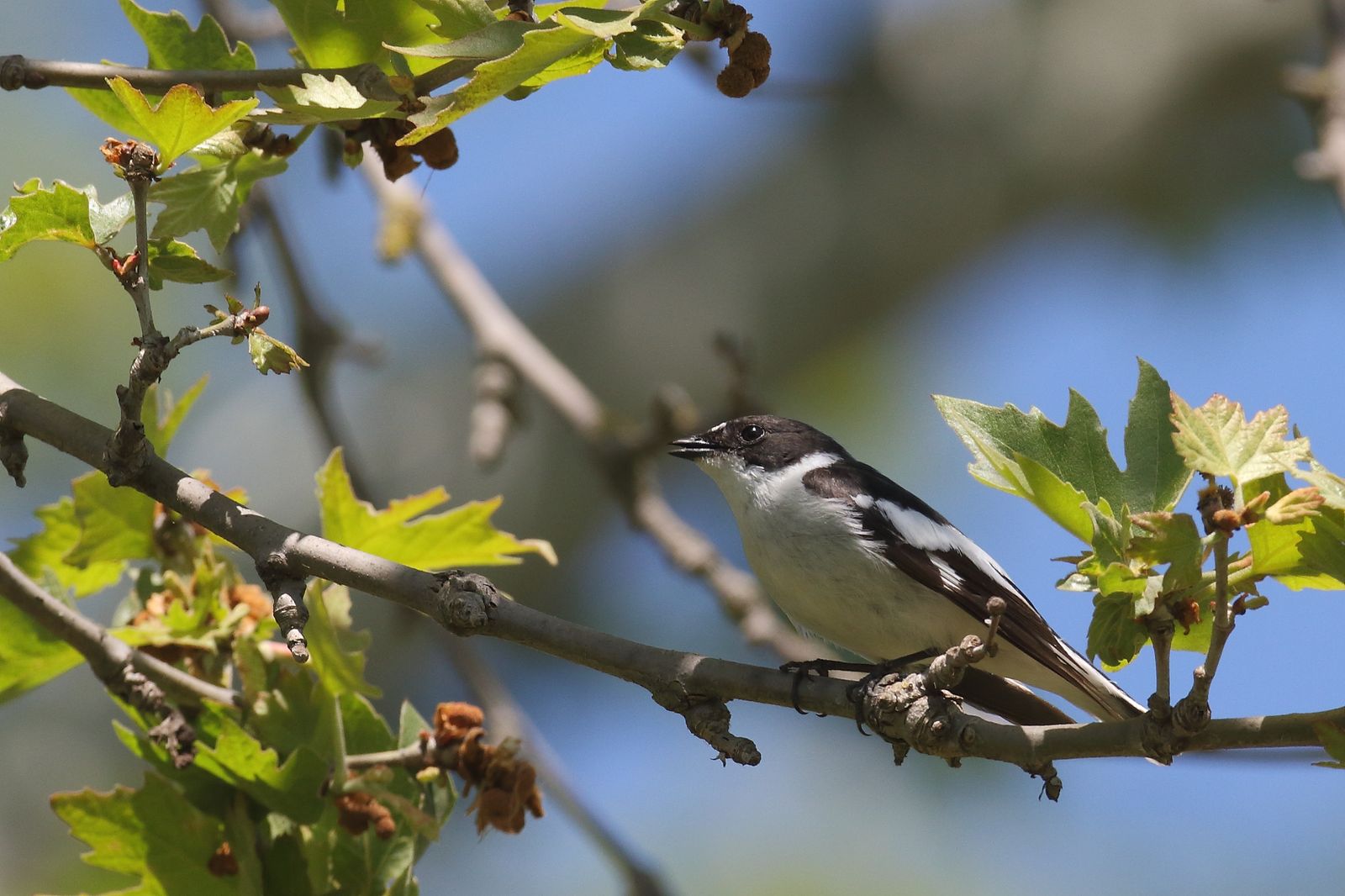
Semicollared Flycatcher · © Birding in Greece - 7
Day 7 · Sat 29 Apr
Lake Karla & Mount Mavrovouni
Lake Karla, Mount Mavrovouni
Lake Karla gave us the biggest day of the trip. The lake was drained in the 1960s and later restored, and today it is one of the best birding sites in Greece.
Great White Pelicans were a new addition to our trip list, while several species of marsh terns and Collared Pratincoles were hunting over the water and the fields. It was also a great day for raptors. A White-tailed Eagle was one of very few records for Thessaly, and we also watched Eleonora's Falcons and a Lanner Falcon searching for food. The wider Karla area has become one of the most reliable places in Greece to see Lanner. A singing Cretzschmar's Bunting on one of the surrounding hills was a special record. Only a few birds breed here, at what is probably the only site for the species in Thessaly and one of its northernmost breeding sites in Greece.
In the afternoon we went up Mount Mavrovouni above the Pelion coast for a lovely walk in its oak forest, a nice change after the lake. Here we added Short-toed Treecreepers, a Eurasian Green Woodpecker and a Black Stork flying over, before we continued to Thessaloniki for the night.
- 8
Day 8 · Sun 30 Apr
Axios Delta National Park
Axios Delta NP
We spent the day in the Axios Delta, just west of Thessaloniki, an area of saltpans, rice fields, river channels and mussel farms. The highlight of the morning was a group of Spur-winged Lapwings, as the Axios is the main breeding site of this species in Greece. Pied Avocets and Black-winged Stilts were nesting along the saltpans, Sandwich Terns were fishing offshore, an Osprey was hunting over the river, and Eastern Olivaceous Warblers were singing in the tamarisks.
In the afternoon we visited the Gallikos river estuary on the edge of Thessaloniki, where we focused on our coastal targets. Mediterranean Gulls were the stars here, and large flocks of waders and flamingos were feeding on the mudflats.
- 9
Day 9 · Mon 1 May
Thessaloniki hills & Lake Koroneia
Lagyna hills, Exochi hills, Lake Koroneia
We spent the morning in the low hills around Thessaloniki. At Lagyna we had good views of Eastern Orphean Warblers and a Booted Eagle.
In the nearby Exochi hills an Eastern Bonelli's Warbler was singing, and we also found Rock Sparrows on the rocky slopes. We spent some time here with the wild orchids that grow on these hills in spring and found several different species.
In the afternoon we visited Lake Koroneia. Black-necked Grebes in breeding plumage were on the water, a Common Quail was singing in the fields, and European Rollers were sitting out in the open countryside. From there we continued to Lake Kerkini.
- 10
Day 10 · Tue 2 May
Lake Kerkini
Lake Kerkini NP
We spent our first full day at Lake Kerkini, at the foot of Mount Belles, one of the most famous wetlands in Greece. The lake was busy with breeding birds. Both Dalmatian and Great White Pelicans were nesting here, the colonies of Pygmy Cormorants, Great Cormorants and Eurasian Spoonbills were full of activity, and White Storks were nesting all around the lake. Black Storks were also feeding along the shore.
Around the lake we found Lesser Spotted Eagles, a Grey-headed Woodpecker and a Masked Shrike, a bird many visitors hope to see in Greece, while European Bee-eaters seemed to be everywhere.
In the afternoon we visited the Aetovouni quarry. A pair of Levant Sparrowhawks was the highlight here, together with a Golden Eagle and a Common Rock Thrush.
- 11
Day 11 · Wed 3 May
A second day at Lake Kerkini
Lake Kerkini NP
We gave Kerkini a second, longer day and explored more of the lake shore. This time we spent more time at the heronry, where Black-crowned Night Herons, Little Egrets and Grey Herons were busy at their nests, and Little Bitterns and Glossy Ibises were coming and going around the colony. Out on the water the Great White Pelicans were present in huge numbers, a real spectacle.
Raptors were again a feature of the day. Black Kites were at their nests, and Red-footed Falcons were hunting over the fields. A Common Kingfisher along one of the channels was a nice addition.
We closed the day in the village, where the local trout festival was under way, and sat down to eat together with the villagers. It was a lovely evening and a real taste of local life around the lake.
- 12
Day 12 · Thu 4 May
A boat trip on Kerkini & Mount Belles
Lake Kerkini NP, Mount Belles
We started the day with a boat trip from Mandraki harbour, which took us out onto the lake among the pelicans. Being on the water so close to the Dalmatian and Great White Pelicans was one of the most memorable moments of the trip. Whiskered and Black Terns were feeding over the lake, and we passed plenty of herons, egrets and Eurasian Spoonbills along the way.
In the afternoon we drove up into the forests of Mount Belles, along the border with North Macedonia, for a completely different set of birds. It was a good afternoon for woodpeckers, with a White-backed Woodpecker and a Black Woodpecker. We also found a European Honey-buzzard, a Willow Tit, Marsh Tits, Common Firecrests, Mistle Thrushes, a Eurasian Treecreeper carrying food for its young, and pairs of Yellowhammers playfully chasing each other.
- 13
Day 13 · Fri 5 May
Vyroneia & Mount Lailias
Lake Kerkini NP, Mount Lailias
We began with an early walk along the old railway tracks at Vyroneia, a quiet spot near the lake that gave us second chances at some of the area's specialities, including a Grey-headed Woodpecker, a Levant Sparrowhawk and a Semicollared Flycatcher.
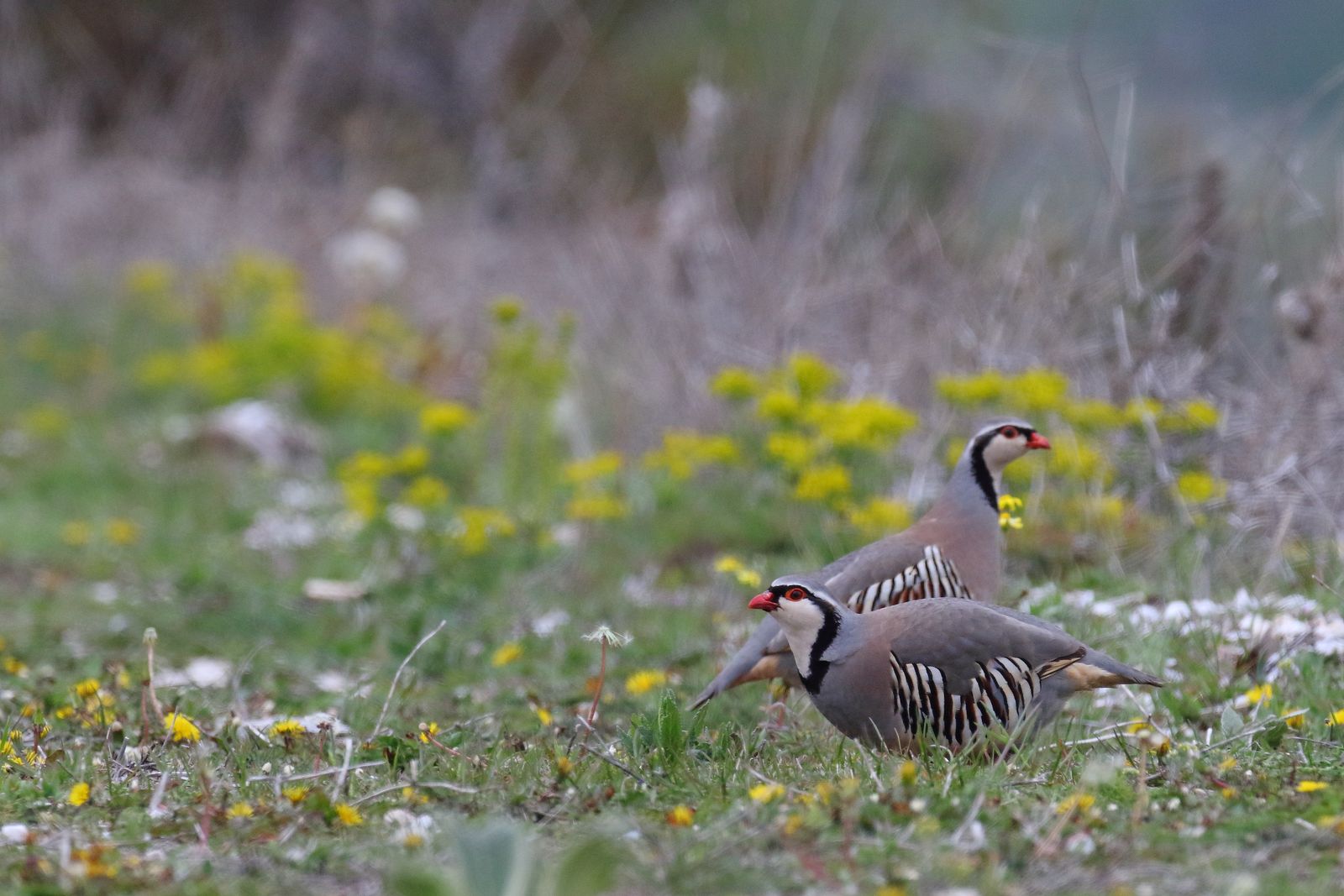
From there we drove up into the forests and open slopes of Mount Lailias above Serres, for the birds of the northern mountains. The highlight was a small group of Rock Partridges. Woodlarks were carrying food to their young, Tree Pipits were displaying over the clearings, and we also enjoyed Rock Buntings, Eurasian Skylarks and a pair of Grey Wagtails feeding their young.
Rock Partridge · © Birding in Greece - 14
Day 14 · Sat 6 May
South to Delphi
Lake Kerkini NP, Delphi, Mount Parnassos
We said goodbye to Kerkini with a last early walk along the railway tracks at Vyroneia, where Eurasian Golden Orioles were calling all around us and we also found a Great Spotted Woodpecker.
The rest of the day was mainly a long drive south. As we reached the foothills of Mount Parnassos we made several stops for wild orchids, a lovely way to break up the journey, and we also visited the archaeological site of Delphi, the ancient sanctuary of Apollo on the slopes of the mountain. Among the ruins and the cliffs above them we enjoyed great views of Western Rock Nuthatches and Blue Rock Thrushes. In the late afternoon we arrived at Kelaria, high on Parnassos, where a group of Alpine Choughs welcomed us, together with Black Redstarts and Northern Wheatears on the rocky slopes.
- 15
Day 15 · Sun 7 May
Euboea Island & back to Athens
Lake Dystos, Agia Marina–Nea Styra ferry route
Our last full day took us to Lake Dystos on the island of Euboea, a marshy lake surrounded by farmland and low hills. The star of the day, and one of the birds of the whole trip, was a Demoiselle Crane that had been staying at the lake, a rare visitor to Greece. It was a wonderful way to finish.
The fields around the lake were full of life too. Red-footed Falcons and Lesser Kestrels were hunting over the open ground, Lesser Grey Shrikes were easy to find, and Black-headed Buntings were singing everywhere.
In the early afternoon we took the ferry from Euboea back to the mainland, with European Shags on the crossing, and drove on to Athens for our last evening together.
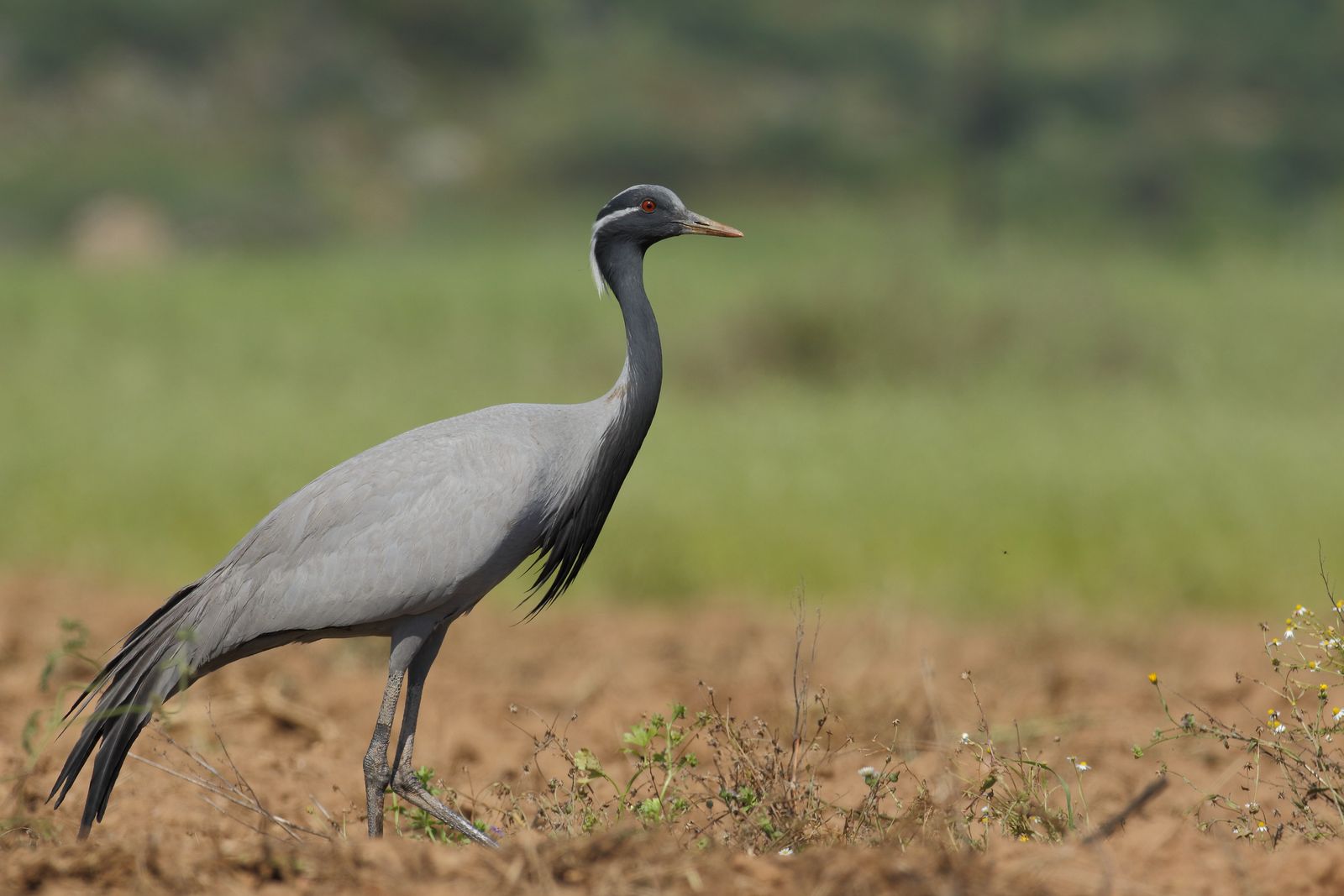
Demoiselle Crane · © Birding in Greece - 16
Day 16 · Mon 8 May
Departure
Transfer to Athens airport and flights home.
Species list
216 species
- Mute Swan Cygnus olor
- Greylag Goose Anser anser
- Common Shelduck Tadorna tadorna
- Ferruginous Duck Aythya nyroca
- Common Pochard Aythya ferina
- Garganey Spatula querquedula
- Northern Shoveler Spatula clypeata
- Gadwall Mareca strepera
- Eurasian Wigeon Mareca penelope
- Mallard Anas platyrhynchos
- Common Quail Coturnix coturnix
- Chukar Alectoris chukar
- Rock Partridge Alectoris graeca
- Greater Flamingo Phoenicopterus roseus
- Little Grebe Tachybaptus ruficollis
- Great Crested Grebe Podiceps cristatus
- Black-necked Grebe Podiceps nigricollis
- Great Spotted Cuckoo Clamator glandarius
- Common Cuckoo Cuculus canorus
- European Turtle Dove Streptopelia turtur
- Collared Dove Streptopelia decaocto
- Common Woodpigeon Columba palumbus
- Rock Dove (& Feral Pigeon) Columba livia
- Demoiselle Crane Grus virgo
- Water Rail Rallus aquaticus
- Common Moorhen Gallinula chloropus
- Eurasian Coot Fulica atra
- Stone-curlew Burhinus oedicnemus
- Pied Avocet Recurvirostra avosetta
- Black-winged Stilt Himantopus himantopus
- Eurasian Oystercatcher Haematopus ostralegus
- Grey Plover Pluvialis squatarola
- Common Ringed Plover Charadrius hiaticula
- Little Ringed Plover Thinornis dubius
- Spur-winged Lapwing Vanellus spinosus
- Kentish Plover Anarhynchus alexandrinus
- Eurasian Curlew Numenius arquata
- Black-tailed Godwit Limosa limosa
- Common Snipe Gallinago gallinago
- Common Sandpiper Actitis hypoleucos
- Wood Sandpiper Tringa glareola
- Common Redshank Tringa totanus
- Spotted Redshank Tringa erythropus
- Common Greenshank Tringa nebularia
- Ruddy Turnstone Arenaria interpres
- Ruff Calidris pugnax
- Curlew Sandpiper Calidris ferruginea
- Temminck's Stint Calidris temminckii
- Dunlin Calidris alpina
- Little Stint Calidris minuta
- Collared Pratincole Glareola pratincola
- Little Tern Sternula albifrons
- Caspian Tern Hydroprogne caspia
- Gull-billed Tern Gelochelidon nilotica
- Whiskered Tern Chlidonias hybrida
- White-winged Black Tern Chlidonias leucopterus
- Black Tern Chlidonias niger
- Sandwich Tern Thalasseus sandvicensis
- Common Tern Sterna hirundo
- Little Gull Hydrocoloeus minutus
- Slender-billed Gull Chroicocephalus genei
- Black-headed Gull Chroicocephalus ridibundus
- Mediterranean Gull Ichthyaetus melanocephalus
- Yellow-legged Gull Larus michahellis
- Yelkouan Shearwater Puffinus yelkouan
- Black Stork Ciconia nigra
- White Stork Ciconia ciconia
- Pygmy Cormorant Microcarbo pygmaeus
- European Shag Gulosus aristotelis
- Great Cormorant Phalacrocorax carbo
- Glossy Ibis Plegadis falcinellus
- Eurasian Spoonbill Platalea leucorodia
- Great White Pelican Pelecanus onocrotalus
- Dalmatian Pelican Pelecanus crispus
- Little Bittern Botaurus minutus
- Little Egret Egretta garzetta
- Black-crowned Night Heron Nycticorax nycticorax
- Squacco Heron Ardeola ralloides
- Great White Egret Ardea alba
- Western Cattle Egret Ardea ibis
- Purple Heron Ardea purpurea
- Grey Heron Ardea cinerea
- Alpine Swift Tachymarptis melba
- Common Swift Apus apus
- Pallid Swift Apus pallidus
- Little Owl Athene noctua
- Tawny Owl Strix aluco
- Osprey Pandion haliaetus
- European Honey-buzzard Pernis apivorus
- Short-toed Eagle Circaetus gallicus
- Lesser Spotted Eagle Clanga pomarina
- Booted Eagle Hieraaetus pennatus
- Golden Eagle Aquila chrysaetos
- Levant Sparrowhawk Tachyspiza brevipes
- Eurasian Sparrowhawk Accipiter nisus
- Pallid Harrier Circus macrourus
- Western Marsh Harrier Circus aeruginosus
- Black Kite Milvus migrans
- White-tailed Eagle Haliaeetus albicilla
- Common Buzzard Buteo buteo
- Long-legged Buzzard Buteo rufinus
- Eurasian Hoopoe Upupa epops
- European Roller Coracias garrulus
- European Bee-eater Merops apiaster
- Common Kingfisher Alcedo atthis
- Grey-headed Woodpecker Picus canus
- Eurasian Green Woodpecker Picus viridis
- Black Woodpecker Dryocopus martius
- Middle Spotted Woodpecker Dendrocoptes medius
- White-backed Woodpecker Dendrocopos leucotos
- Great Spotted Woodpecker Dendrocopos major
- Syrian Woodpecker Dendrocopos syriacus
- Lesser Spotted Woodpecker Dryobates minor
- Lesser Kestrel Falco naumanni
- Common Kestrel Falco tinnunculus
- Red-footed Falcon Falco vespertinus
- Eleonora's Falcon Falco eleonorae
- Eurasian Hobby Falco subbuteo
- Peregrine Falcon Falco peregrinus
- Lanner Falcon Falco biarmicus
- Ring-necked Parakeet Psittacula krameri
- Monk Parakeet Myiopsitta monachus
- Eurasian Golden Oriole Oriolus oriolus
- Masked Shrike Lanius nubicus
- Lesser Grey Shrike Lanius minor
- Woodchat Shrike Lanius senator
- Red-backed Shrike Lanius collurio
- Alpine Chough Pyrrhocorax graculus
- Eurasian Jay Garrulus glandarius
- Common Magpie Pica pica
- Eurasian Jackdaw Coloeus monedula
- Rook Corvus frugilegus
- Hooded Crow Corvus (corone) cornix
- Common Raven Corvus corax
- Eurasian Penduline Tit Remiz pendulinus
- Eurasian Blue Tit Cyanistes caeruleus
- Great Tit Parus major
- Coal Tit Periparus ater
- Sombre Tit Poecile lugubris
- Marsh Tit Poecile palustris
- Willow Tit Poecile montanus
- Woodlark Lullula arborea
- Eurasian Skylark Alauda arvensis
- Crested Lark Galerida cristata
- Greater Short-toed Lark Calandrella brachydactyla
- Calandra Lark Melanocorypha calandra
- Zitting Cisticola Cisticola juncidis
- Icterine Warbler Hippolais icterina
- Eastern Olivaceous Warbler Iduna pallida
- Sedge Warbler Acrocephalus schoenobaenus
- Common Reed Warbler Acrocephalus scirpaceus
- Great Reed Warbler Acrocephalus arundinaceus
- Sand Martin Riparia riparia
- Eurasian Crag Martin Ptyonoprogne rupestris
- Barn Swallow Hirundo rustica
- Western House Martin Delichon urbicum
- European Red-rumped Swallow Cecropis rufula
- Long-tailed Tit Aegithalos caudatus
- Cetti's Warbler Cettia cetti
- Wood Warbler Phylloscopus sibilatrix
- Eastern Bonelli's Warbler Phylloscopus orientalis
- Common Chiffchaff Phylloscopus collybita
- Garden Warbler Sylvia borin
- Eurasian Blackcap Sylvia atricapilla
- Lesser Whitethroat Curruca curruca
- Eastern Orphean Warbler Curruca crassirostris
- Common Whitethroat Curruca communis
- Ruppell's Warbler Curruca ruppeli
- Sardinian Warbler Curruca melanocephala
- Eastern Subalpine Warbler Curruca cantillans
- Common Firecrest Regulus ignicapilla
- Western Rock Nuthatch Sitta neumayer
- Eurasian Nuthatch Sitta europaea
- Eurasian Treecreeper Certhia familiaris
- Short-toed Treecreeper Certhia brachydactyla
- Eurasian Wren Nannus troglodytes
- Common Starling Sturnus vulgaris
- Mistle Thrush Turdus viscivorus
- Song Thrush Turdus philomelos
- Eurasian Blackbird Turdus merula
- Spotted Flycatcher Muscicapa striata
- European Robin Erithacus rubecula
- Common Nightingale Luscinia megarhynchos
- Semicollared Flycatcher Ficedula semitorquata
- Collared Flycatcher Ficedula albicollis
- European Pied Flycatcher Ficedula hypoleuca
- Black Redstart Phoenicurus ochruros
- Common Redstart Phoenicurus phoenicurus
- Common Rock Thrush Monticola saxatilis
- Blue Rock Thrush Monticola solitarius
- Whinchat Saxicola rubetra
- European Stonechat Saxicola rubicola
- Eastern Black-eared Wheatear Oenanthe melanoleuca
- Northern Wheatear Oenanthe oenanthe
- Rock Sparrow Petronia petronia
- Eurasian Tree Sparrow Passer montanus
- Spanish Sparrow Passer hispaniolensis
- House Sparrow Passer domesticus
- Grey Wagtail Motacilla cinerea
- Western Yellow Wagtail Motacilla flava
- White Wagtail Motacilla alba
- Tawny Pipit Anthus campestris
- Tree Pipit Anthus trivialis
- Red-throated Pipit Anthus cervinus
- Common Chaffinch Fringilla coelebs
- Hawfinch Coccothraustes coccothraustes
- European Greenfinch Chloris chloris
- Common Linnet Linaria cannabina
- European Goldfinch Carduelis carduelis
- European Serin Serinus serinus
- Black-headed Bunting Melophus melanocephalus
- Corn Bunting Emberiza calandra
- Rock Bunting Emberiza cia
- Cretzschmar's Bunting Emberiza caesia
- Cirl Bunting Emberiza cirlus
- Yellowhammer Emberiza citrinella
Species names and order follow our Checklist of the Birds of Greece.
Want a trip like this?
See our tours →